
March Logistics Updates
- Return to the Suez Canal
Following the outbreak of conflict in the region, several ocean carriers temporarily rerouted vessels away from the Suez Canal and Gulf of Aden, instead sailing via the Cape of Good Hope. During this period, some marine insurance providers applied exclusions or restrictions to cargo transiting the Suez Canal and surrounding waters.
We have now been informed that the first carriers, including Maersk, Hapag-Lloyd, and CMA CGM, have started to reinstate services through the Suez Canal. As a result, certain upcoming shipments may once again transit this route, depending on operational requirements and carrier discretion.
At present, only a limited number of services are affected, though further resumptions are expected over time.
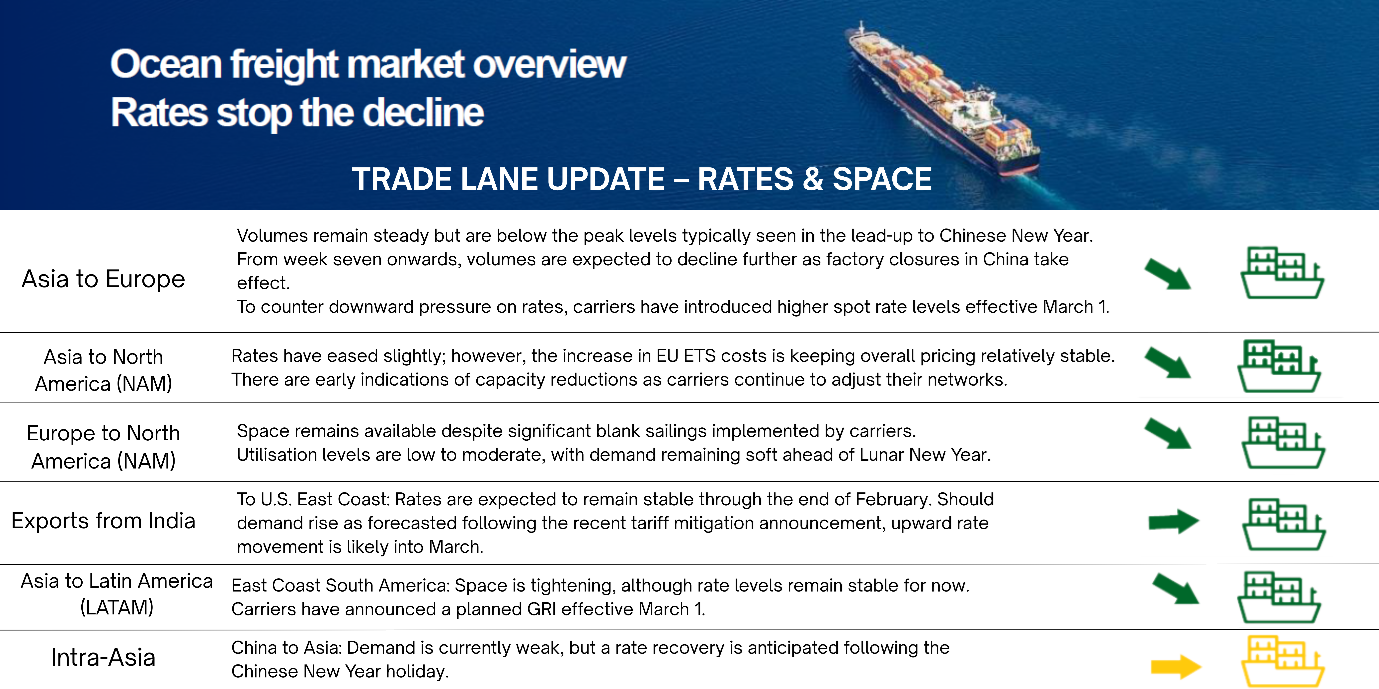
- Ocean freight market overview
- Latest on US Tariffs
On 20 February 2026, the Supreme Court of the United States ruled that President Donald Trump exceeded his authority in imposing broad tariffs under the International Emergency Economic Powers Act (IEEPA). This decision immediately nullified several major tariff measures, including the 10% “fentanyl” tariff and certain reciprocal duties on Chinese imports.
The Court did not address potential refunds for the estimated $130+ billion already collected, leaving the matter to lower courts and prolonging uncertainty.
In response, President Trump invoked Section 122 of the Trade Act of 1974, which allows for temporary tariffs of up to 15% for a period of 150 days.
A 10% global tariff was introduced on 20–21 February and was subsequently increased within 24 hours to 15% — the maximum permitted under Section 122. These tariffs now replace the previously invalidated IEEPA measures.
Certain imports remain exempt from the 10–15% global tariff, including:
- Certain foods
- Critical minerals
- Electronics
- Cars
- Goods from Canada and Mexico under USMCA
Summary
The global logistics landscape continues to shift, with developments such as the gradual return of Suez Canal routes, stabilising freight rates, and new U.S. tariff measures influencing international trade. At Exertis Supply Chain Services, we closely monitor these changes to ensure our customers stay informed, adaptable, and ready to respond to evolving market conditions.