Pros and cons of launching a product on Amazon in Europe
Launching a product on Amazon is now a core expansion strategy for brands entering Europe. As an eCommerce platform, Amazon gives access to millions of shoppers, trusted infrastructure, and fast routes to market.
Exertis Supply Chain Services (ESCS) helps brands streamline and automate e-commerce marketplace listings, sales, and fulfillment across multiple countries.
List once with ESCS, and we manage sales, logistics, inventory, pricing, and marketing on your preferred marketplaces.
We are uniquely positioned to support brands with a strong presence across Europe, including operational bases in Ireland, Poland and China, enabling seamless cross-border logistics and marketplace expansion.
Key takeaways
- Launching on Amazon in Europe offers instant access to millions of shoppers and a trusted eCommerce platform
- Tools like Fulfillment by Amazon (FBA), multichannel fulfillment, and Amazon’s inventory management simplify international logistics
- Participation in Brand Registry and Amazon programs boosts customer confidence and protects intellectual property
- Brands face high competition, algorithm pressures, and variety of fees, impacting profit margins
- Dependency on selling channels, platform terms of service, and limited brand control can restrict brand ownership
- Success requires careful planning of product uploads, localized payment systems, and cross-border operations
- Choosing between Amazon Vendor Central (1P) and Amazon Seller Central (3P/FBA/FBM/SFP) affects control, fees, and fulfillment; expert support can guide strategy
Between Vendor Central, Brand Registry, Fulfillment by Amazon, and a continent-wide Amazon fulfillment center network, businesses can scale quickly.
Brands must also understand the operational realities, including international logistics, compliance, the variety of fees, Amazon’s terms of service, and the impact of Amazon’s algorithm to protect profit margins and long-term product performance.
This article outlines the advantages and challenges of launching products on Amazon in Europe.
If you’re ready to take the next step with your business, contact our friendly team at ESCS for expert support and guidance.
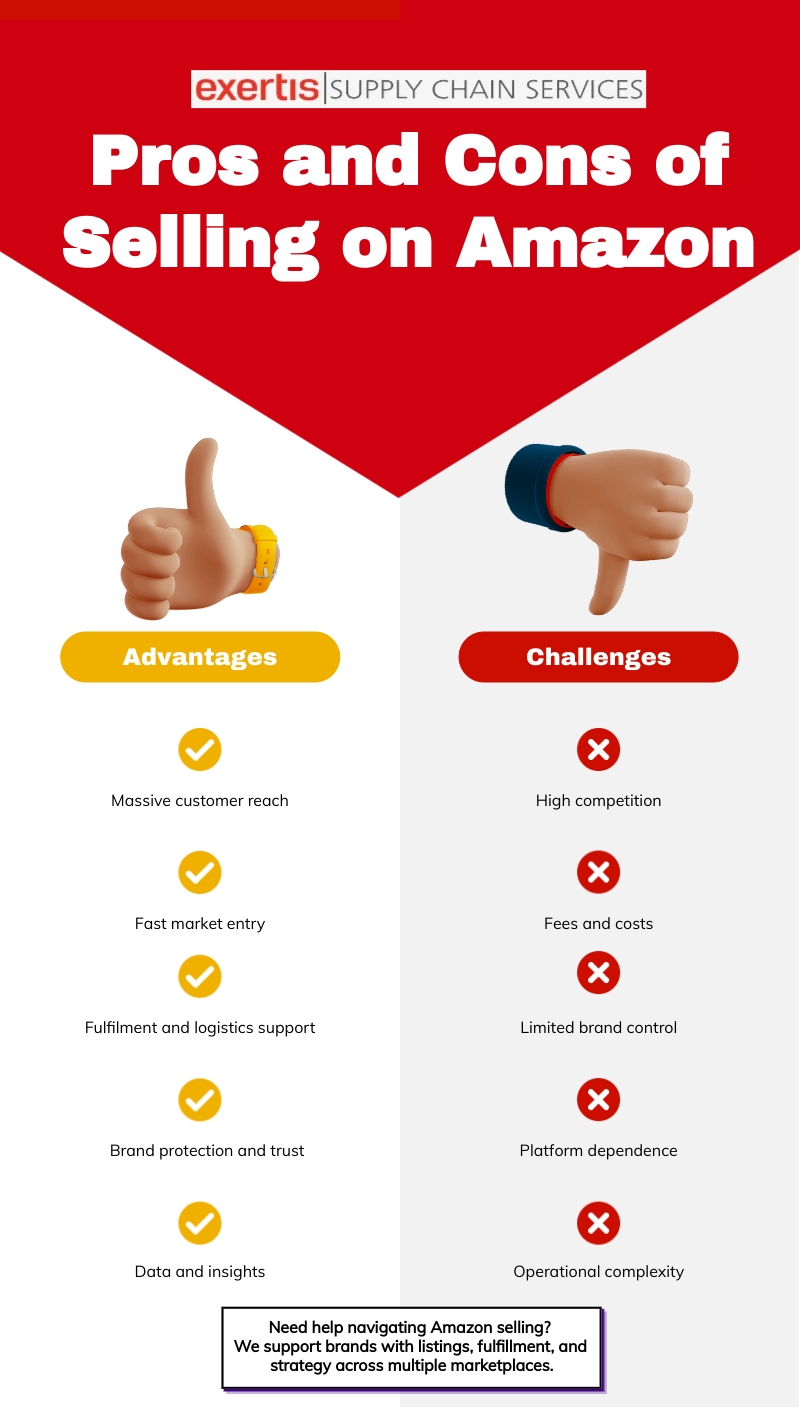
Advantages of launching a product on Amazon in Europe
1. Access to a large customer base in minutes
Amazon offers immediate reach. Brands gain visibility to a broad customer base, enabling fast testing of product appeal, product mix, and demand across multiple selling channels. Listings and product uploads can go live within minutes, supporting rapid market coverage.
This scale supports validation of new product lines, expansion of a product portfolio, and wider business on platforms beyond a standalone website. Amazon Prime strengthens conversion rates by offering fast and reliable delivery.
2. Streamlined logistics and inventory management
Amazon’s infrastructure supports every stage of inventory management and multichannel fulfillment. Through Fulfillment by Amazon, businesses can outsource storage, packing, shipping, returns, and customer service.
Key operational advantages include:
- Unified cross-border distribution
- Support for returns and refunds
- Standardized customer service
- Integrated forecasting tools
- Automated replenishment via a third-party automated feed tool
- Access to localized payment systems that simplify European expansion
This reduces operational pressure and lets internal teams focus on product development and marketing.
3. Enhanced trust, brand protection, and customer confidence
Amazon’s reputation gives immediate credibility. Positive experiences often lead to a positive review, strengthening product performance and customer retention. Brand Registry protects intellectual property, reducing counterfeit risks and improving brand safety.
Events such as the Amazon Vendor Summit help brands understand market dynamics and plan for broader expansion.
4. Additional business advantages
Other benefits include:
- Ability to expand direct-to-consumer across Europe with minimal local setup
- A platform to test niche categories
- Access to Amazon insights that refine business growth strategy
- Exposure to Amazon’s proven marketing strategy that boosts visibility
- Predictable terms of cost for fulfillment and marketing
- Support for brands with limited resource availability or no standalone eCommerce operations
Challenges of launching on Amazon in Europe
1. Intense competition and algorithm pressures
Amazon’s scale brings a high level of competition. Understanding how Amazon’s algorithm ranks listings is essential. This poses challenges for low-margin items, where aggressive competition can erode profit margins.
For example, winning the Featured Offer (formerly known as the Buy Box) requires competitive pricing, strong fulfillment performance, and ongoing optimization.
How to win the Featured Offer (previously called Buy Box) on Amazon
A) Become Buy Box eligible
- Ensure your seller performance is strong, including order defect rate, cancellation rate, and late shipment rate.
- Maintain accurate inventory levels and properly manage listings
B) Compete to win the Buy Box
Once eligible, your product competes with other sellers for the Featured Offer. Factors include:
- Pricing: Keep your product reasonably priced compared to competitors.
- Inventory: Maintain sufficient stock to meet demand.
- Shipping Options: Offer multiple shipping methods, including free shipping if possible.
- Customer service: Provide excellent service to generate positive reviews and ratings.
C) Additional tips
- Regularly review and optimize listings and campaigns for impressions.
- Monitor seller metrics to maintain eligibility and competitiveness.
2. Dependence on Amazon’s terms and systems
Operating on Amazon requires adherence to strict terms of service. Updates can affect communication, shipping methods, and overall account standing.
Businesses accustomed to full control may find this restrictive.
3. Fees, fulfillment costs, and financial complexity
European expansion introduces costs beyond typical retail normal cost structures. These include:
- Referral fees
- Fulfillment fees
- Long-term storage charges
- Additional cost for inbound processing or placement
- Promotional spend and marketing costs
Sellers must also manage the reimbursement claims process for damaged units, lost stock, or incorrect charges.
These factors influence annual revenue forecasts and margin planning.
4. Limited brand control and customer ownership
Amazon manages most communication with customers, reducing brand control over packaging and long-term retention strategies.
Building brand identity within a standardized environment requires additional effort.
5. Operational complexity and inventory pressures
Managing stock across European countries introduces complexity. Amazon demands consistent availability, accurate forecasting, and strong replenishment processes.
Brands must address:
- Overstocking
- Stockouts
- Returns management
- Local compliance issues
- Cross-border international logistics
These pressures can complicate cash flow and planning.
Is Amazon selling worth it?
Selling on Amazon is worthwhile for brands seeking fast access to customers, reliable fulfillment, and structured testing of new product categories.
The platform delivers strong reach, predictable operations, and cost-efficient scaling for both emerging and established businesses.
However, Amazon is not a set-and-forget channel. It requires ongoing optimization, pricing discipline, and careful management of advertising spend and inventory.
Brands must weigh speed and scale against competition, fees, and reduced customer ownership.
For most companies, Amazon works best as part of a wider search engine and multichannel fulfillment strategy rather than the sole sales channel.
Amazon Vendor Central vs Seller Central: Which is right for your business?
Choosing between Vendor Central and Seller Central depends on margins, operational control, and long-term growth plans.
A first-party Amazon vendor (Amazon vendor / 1P) sells at wholesale prices to Amazon. Amazon owns the inventory, sets retail prices, and manages most logistics and customer interactions.
This suits brands that want simplified operations and broad distribution, but it reduces control.
A third-party Amazon seller (Amazon Seller / 3P) sells directly to customers through Seller Central.
This model offers more flexibility in pricing, marketing, and stock management. Sellers can choose between FBA (Fulfilled by Amazon), FBM (Fulfilled by Merchant), and SFP (Seller Fulfilled Prime) depending on capability and margin structure.
ESCS supports brands using both Vendor Central and Seller Central, offering operational setup, margin analysis, and end-to-end European expansion support.
Ready to scale your business on Amazon?
For brands targeting European expansion, Amazon remains a powerful channel, provided you understand the landscape and prepare accordingly. You’d be right in thinking there is a lot to consider, and the reality of executing well against everything that will make your Amazon listings a success can be challenging for new brands into the market.
This is where ESCS’s specialist Managed e-Commerce (internal link) division can help. We act as your merchant of record while providing real-time visibility of sales and inventory across all markets. Leveraging our expertise and systems, ESCS ensures your products reach customers efficiently while you retain full oversight of your brand, profitability, stock and marketing spend.
Exertis supports every stage of your European market entry, from supply chain setup to vendor management and strategic planning. Contact us to strengthen your launch strategy and scale across Amazon’s European marketplaces.